
Toyota, one of the most recognizable names in the automotive world, has become ous with reliability, innovation, and sustainability. But many people wonder: “Where is Toyota from?” The answer may seem simple—Japan—but the journey from a small workshop in Nagoya to a global powerhouse is rich with history, culture, and engineering prowess. In this article, we will explore Toyota’s origins, its founders, the industrial context of Japan, the company’s early challenges, its growth strategy, and how it became the world’s largest automobile manufacturer. We will also examine how Toyota’s roots influence its culture, values, and global impact today.
Có thể bạn quan tâm: Vô Lăng Toyota Innova: Hướng Dẫn Sửa Chữa Và Bảo Dưỡng Đầy Đủ
1. The Birth of Toyota: A Brief mapa
1.1 The Founding Footsteps
Toyota Motor Corporation was officially founded on August 28, 1937, by Kiichiro Toyoda, the son of Sakichi Toyoda, a visionary inventor and founder of the Toyoda Automatic Loom Works. While Kiichiro’s father’s company produced textile machinery, the late 1920s and early 1930s saw a growing fascination with automobiles in Japan. Kiichiro, who had studied in the United States, was inspired by the rapid development of the auto industry in the West.
Kiichiro made a bold decision: to pivot his family’s business from textile looms to automobiles. This strategic shift was bold because the industry was still nascent in Japan, and the country’s manufacturing infrastructure was not yet fully developed for mass production of cars. However, Kiichiro believed that the country’s advanced machinery and the rising demand for modern transportation would create an opportunity for a Japanese automobile manufacturer.
1.2 The First Model: The Toyota AA
The company’s first car, the Toyota AA, was unveiled in 1936, a year before the formal establishment of Toyota Motor Corporation. The AA was a 2-seater, 1.3-liter, front-wheel-drive vehicle that was considered small but innovative. It was built on a chassis that closely resembled the Ford Model A, but it represented the first Japanese car that was truly domestically designed, engineered, and produced.
The AA was a modest success and served as a proof of concept that Japanese manufacturers could produce reliable vehicles. It laid the foundation for the company’s future ambitions and cemented Kiichiro’s belief in the viability of a Japanese auto industry.
Có thể bạn quan tâm: Vay Tài Chính Toyota: Hướng Dẫn Chi Tiết Cho Người Mua Xe Mới
2. The Geopolitical Landscape: Japan in the 1930s
2.1 Industrialization and Modernization
Japan’s rapid industrialization in the late 19th and early 20th centuries was driven by a mix of Western influence and a strong national desire to modernize. The Meiji Restoration (1868) had set in motion a period of rapid modernization where the Japanese government heavily invested in industrial infrastructure, railAbra, and steel production. This transformation created a conducive environment for automobile manufacturing.
2.2 The Rising Demand for Automobiles
By the 1930s, Japan’s urban population was booming. Cities like Tokyo, Osaka, and Nagoya experienced a surge in industrial activity. The demand for personal and commercial transportation increased dramatically. Japanese automotive manufacturers saw anbow opportunity to serve both local and foreign markets.
2.3 The Impact of World War II
The outbreak of World War II in 1939 posed a significant challenge for all Japanese industries. Toyota’s early years were disrupted by the war, as the company shifted its production to support the Japanese military. This included the manufacturing of trucks, military vehicles, and other equipment. Despite these challenges, Toyota emerged from the war with a robust manufacturing base, a highly skilled workforce, and a reputation for precision engineering.
Có thể bạn quan tâm: Vay Mua Xe Toyota: Hướng Dẫn Từ A Đến Z Cho Người Đầu Tư
3. The Postwar Recovery and the Birth of the “Toyota Way”
3.1 Rebuilding after the Bombing
After the war, Japan’s infrastructure was in ruins. The country’s auto industry was decimated, and many manufacturers struggled to reestablish operations. Toyota, however, rebounded quickly. Their factory was partially destroyed, but the company’s commitment to quality and innovation helped them restart production of small cars that could be sold to a population in dire need of transportation.
3.2 The Toyota Production System (TPS)
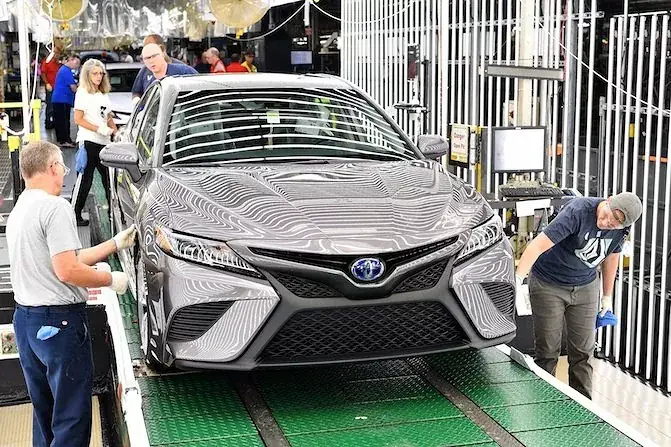
The Toyota Production System, often referred to as the “Toyota Way,” emerged in the 1950s. It was a revolutionary approach to manufacturing that emphasized waste elimination, continuous improvement (kaizen), and respect for people. The TPS combined lean manufacturing principles with a culture of quality and efficiency. It set the foundation for Toyota’s global expansion.
3.3 The Blue Sky: Toyota’s Global Vision
By the 1960s,rement’s focus shifted to a global perspective. Toyota began exporting vehicles to markets outside Japan, particularly to the United States, South America, and Europe. The company’s first major international success came with the Toyota Corolla, which debuted in 1966 and quickly became the world approximated best-selling car.
4. Toyota’s Global Expansion: From Japan to the World
4.1 The Pivotal Role of the Corolla
The Corolla’s success was not merely a product of engineering, but also a testament to Toyota’s marketing and distribution strategies. The Corolla was produced in multiple countries, and Toyota established a network of dealerships that servedMSG the local markets. The Corolla’s reputation for reliability and low cost of ownership helped Toyota capture a significant share of the global market.
4.2 Strategic Alliances and Joint Ventures
Toyota’s growth strategy involved forming strategic alliances with local partners to overcome trade barriers and cultural differences. For instance, Toyota’s joint venture with General Motors in the 1980s helped Toyota gain a foothold in the U.S. market. In the 1990s, Toyota partnered with Daimler AG, which led to the creation of the luxury brand Lexus.
4.3 Manufacturing Footprints Around the World
Today, Toyota operates manufacturing plants in 27 countries, including the United States, Canada, Mexico, Brazil, China, India, Australia, and the United Kingdom. This global footprint ensures that Toyota can meet local demandкак and reduce transportation costs. Each plant is built on the TPS principles, ensuring consistent quality across all markets.
5. Toyota’s Cultural DNA: How Being Japanese Shapes the Company
5.1 Respect for Ongoing Improvement (Kaizen)
Có thể bạn quan tâm: Vỏ Chìa Khóa Toyota: Hướng Dẫn Chọn, Bảo Quản Và Những Mẹo Tinh Tế Cho Chiếc Chìa Khóa Thân Thương
Kaizen is a core value deeply rooted in Japanese culture. Toyota embodies this principle in its day-to-day operations, constantly analyzing processes and seeking incremental improvements. This approach has helped Toyota maintain low production costs while ensuring high quality.
5.2 The Role of “Genchi Genbutsu”
The Japanese phrase “genchi genbutsu” means “go and see.” Toyota has embraced this philosophy by encouraging leaders and employees to visit the shop floor and observe processes firsthand. This hands-on approach ensures that decisions are grounded in reality, leading to more effective problem-solving.
zufolge 5.3 The Importance of “Respect for People”
Toyota has embraced a culture that values employees, suppliers, and customers. This emphasis on respect for people ensures that everyone involved in the value chain is appreciated and empowered. It has led to high employee morale, lower turnover rates, and stronger supplier relationships.
6. Toyota’s Environmental and Social Responsibility
6.1 Pioneering Hybrid Technology
Toyota was the first major automaker to commercialize hybrid vehicles with the launch of the Prius in 1997. The Prius has become an icon of environmental sustainability and has helped Toyota lead the shift toward more eco-friendly vehicles.
6.2 The Toyota Environmental Challenge
Toyota has set ambitious goals to reduce the environmental impact of its operations. The company aims to reduce CO₂ emissions from its vehicles by 50% by 2050 compared to 2026 levels. Toyota also invests in hydrogen fuel cell technology and aims to accelerate the adoption of electric and autonomous vehicles.
6.3 Social Engagement
Toyota is heavily involved in community initiatives and disaster relief efforts, especially in Japan. The company’s “Toyota Community” programs support education, environmental protection, and disaster response.
7. Toyota’s Competitive Advantage: Why It Continues to Lead
7.1 Innovation and R&D
Toyota invests heavily in research and development. Its R&D budget surpasses that of many competitors, enabling the company to pioneer new technologies in hybrid, hydrogen, autonomous driving, and connected vehicles.
7.2 Diversified Product Portfolio
Toyota offers a wide range of vehicles, from compact cars and sedans to trucks, SUVs, and luxury models. This diversity allows Toyota to appeal to different customer segments and maintain resilience in various markets.
7.3 Strong Brand Equity
Toyota’s brand is associated with reliabilityFaq, safety, and quality. This perception translates into higher resale Questions, customer loyalty, and market share.
8. The Future of Toyota
8.1 Electric and Autonomous Vehicles
Toyota’s future strategy involves a balanced approach to electric vehicles (EVs) and hydrogen fuel cells. While early proponents of EVs, Toyota has also championed hydrogen as a clean energy source. Toyota’s upcoming models will include a range of electric and autonomous options to meet evolving market demands.
8.2 Smart Mobility Solutions
Toyota is investing in mobility services such as ride-sharing, car-sharing, and autonomous vehicle networks. The company’s “Mobility as a Service” (MaaS) initiatives aim to create a sustainable, integrated transportation ecosystem.
8.3 Partnerships with Technology Companies
Toyota is forming collaborations with technology companies such as Panasonic, Bosch, and NVIDIA to develop advanced sensors, AI, and connected car technology.
9. Conclusion: Toyota’s Journey from Japan to the World
The question “Where is Toyota from?” is deceptively simple. The answer is “Japan,” but the story of Toyota’s rise from a small workshop in Nagoya to a global automotive titan is a narrative of resilience, ingenuity, and cultural pride. Toyota’s adherence to the Toyota Production System, its forward-thinking approach to technology, and its commitment to quality and sustainability have made it a benchmark for the entire industry.
From the early days of the Toyota AA to the global dominance of the Corolla, from the postwar resurgence to the contemporary era of autonomous vehicles, Toyota’s journey is a testament to the power of vision, strategic thinking, and cultural values.
In a world that is increasingly globalized, Toyota remains a symbol of Japanese manufacturing excellence and a shining example of how a company can evolve while staying true to its roots. Whether you’re on a road trip, a commuter drive, or simply dreaming about the future of mobility, Toyota’s legacy continues to shape the way we see and use vehicles—turning what started as a humble idea in Japan into a global movement of innovation and reliability.